Wednesday, April 13, 2011

Mormon Funeral Potatoes Go National


Cook’s Country magazine features Funeral Potatoes in its May issue and credits Mormon for coming up with the dish’s name, although the dishes goes by other names in other parts of the country.   
“Mormons call it ‘Funeral’ or ‘Ward Party’ potatoes. In the South, it’s ‘hash brown casserole, but I’ve heard it called ‘neighborhood potatoes in Massachusetts and ‘cheesy potatoes’ in Washington,” writes the Cook’s Country author, Sarah Gabriel. 
When I did a story on Funeral Potatoes a few years ago, I asked food editor friends across the country if they were familiar with the recipe, and what they called it.  It seemed that Utah was the only place that called them Funeral Potatoes. In Wisconsin, they're known as Heart-Stopper Hash Browns, for all their artery-clogging sour cream, butter and cheese. In New Jersey, they're Party Potatoes. In Detroit, they're Cheesy Potato Casserole. Folks in Pennsylvania call them Pittsburgh Potatoes. In a Virginia cookbook, they're a Church Social Potato Casserole, and in Florida, they're Churchlady Potatoes.
In fact, most Utahns didn't start calling them Funeral Potatoes until the past 15 years or so. By that time, they were a staple at  dinners given for bereaved friends and family after an LDS funeral. Relief Society presidents heading up the after-funeral dinners say these potatoes go well with ham, and are easy for other ward members to make and bring. The unofficial name stuck.
When they got their own 2002 Winter Olympics pin, they were firmly entrenched , as part of Utah food culture, along with fry sauce and green Jell-O. 
The recipe has appeared by other names in community cookbooks and on packages of frozen hash browns. The hash browns are swimming in sour cream, grated cheese, and cream-of-something soup (mushroom, chicken, celery or potato, depending on your recipe and what's in your pantry). Crushed, buttery cornflakes are the usual topping.
The Cook’s Country article revises the recipe by ditching the “gloppy” cream of chicken soup and making a from-scratch cheese sauce instead. Sour-cream-and-onion potato chips are swapped for the buttered cornflake crumbs. 
The result? Still potatoes “to die for.”  But I wonder if busy cooks would take the time to make the cheese sauce, or whether they are just content to open up a can, gloppy or not. Here's a comparison of the Cook's County version with the recipe from "The Essential Mormon Cookbook." 
Which is best? You decide..

FUNERAL POTATOES
3 tablespoons unsalted butter
2 onions, chopped fine
1/4 cup all-purpose flour
1 1/2 cups low-sodium chicken broth
1 cup half-and-half
1 3/4 teaspoons salt
1/2 teaspoons dried thyme
1/4 teaspoon pepper
2 cups shredded sharp cheddar cheese
9 cups (1 30-ounce bag) frozen shredded hash brown potatoes
1/2 cup sour cream
4 cups sour-cream-and-onion potato chips, crushed
Adjust oven rack to middle position and heat oven to 350 degrees. Melt butter in a Dutch oven (or pot) over medium-high heat. Cook onion until softened, about 5 minutes. Add flour and cook, stirring constantly, until golden, about 1 minute. Slowly whisk in broth, half-and-half, salt, thyme, and pepper and bring to a boil. 
Reduce heat to medium-low and simmer, stirring occasionally, until slightly thickened, 3-5 minutes. Off heat, whisk in cheddar until smooth. 
Stir potatoes into sauce, cover, and cook, stirring occasionally, over low heat until thawed, about 10 minutes. Off heat, stir in sour cream until combined.
Scrape mixture into a 13-by-9-inch baking dish and top with potato chips. Bake until golden brown, 45-50 minutes. Let cool 10 minutes. Serves 8-10.
Make ahead: potato mixture can be refrigerated in baking dish, covered with aluminum foil, for up to 2 days. To finish, bake potatoes 20 minutes, then uncover and top with potato chips. Bake an additional 45-50 minutes.
— Cook’s Country 
FUNERAL POTATOES
1 32-ounce bag frozen shredded hash browns
2 cans cream of chicken soup
2 cups sour cream
1 cup grated cheese
 1/2 cup butter, melted
1/3 cup chopped onion
2 cups crushed cornflakes
2 tablespoons butter, melted 
Peel potatoes and boil 30 minutes, until just tender. Cool and grate into a greased 9-by-13-inch baking dish (or put hash browns into the baking dish). Combine soup, sour cream, cheese, the 1/2 cup melted butter, and onions. Gently blend into potatoes. Combine crushed cornflakes and the 2 tablespoons melted butter. Sprinkle on top. Bake at 350 degrees for 30 minutes. Makes 12 servings.
-- “The Essential Mormon Cookbook,” by Julie Badger Jensen

As for my opinion, I never use the butter that the recipe calls for, and I use reduced-fat sour cream and low-fat cream of chicken soup. But, I'm afraid, those calorie-cutting attempts barely mitigate the diet damage. 

Tuesday, April 12, 2011

Culinary Expedition in Charleston


Today marks 150 years since the opening shots of the Civil War were fired in the harbor of Charleston, S.C.  So it was a cool thing to get a chance to be in Charleston last week for the National Chicken Council’s Food News Seminar. It offered great opportunities to learn more about the culture and cuisine, known as “Lowcountry.” 

Seminar topics ranged from Gullah culture and cuisine, nutrition in walnuts, the chocolate-milk-in-schools debate, the rising prices of food, changes in the perishable aisles of your grocery store, and the controversial practice of “plumping” chicken with salt water.  
We watched a cooking demo on Lowcountry cuisine by Matt & Ted Lee, whose Country Captain Chicken beat Bobby Flay’s in a Food Network throwdown. 
We also visited the the Dock Street Theater, first opened in 1736. 


We visited America’s only tea plantation, the Charleston Classics Tea Plantation on Wadmalaw Island. We also went to the Firely Distillery (and no, I didn't participate in the tastings at either of these places, in case you're all wondering!)  

The  barrier islands of South Carolina are home to the Gullah, descendants of African-American slaves. Their isolation allowed them to preserve many African customs such as basket weaving, rice cultivation and shrimp fishing.
Charlotte Jenkins, owner of Gullah Cuisine restaurant, cooked a fabulous lunch of  shrimp with gravy over grits, Gullah jerk chicken (mildly seasoned than Caribbean jerk), deviled crab, okra gumbo, collard greens, and cornbread. There were three different kinds of rice — Okra perlou (a Lowcountry term for pilaf), red rice (with a little tomato-y base) and Gullah rice (flavored with chicken, sausage and shrimp). I loved the pecan squares (similar to pecan pie) for dessert. 

We were treated to a performance by Gullah gospel singers.

Local sweetgrass weaver Henrietta Snype showed us the tradition that’s been handed down through her family for generations. 
As one would expect at a chicken industry meeting, the menus included fried chicken, barbecued chicken, grilled chicken, poached chicken, smoked chicken, chicken galatine, chicken mousse appetizers, and chicken sausage. I especially enjoyed the locally caught shrimp and crab. Rice, grits and collard greens were also popular.
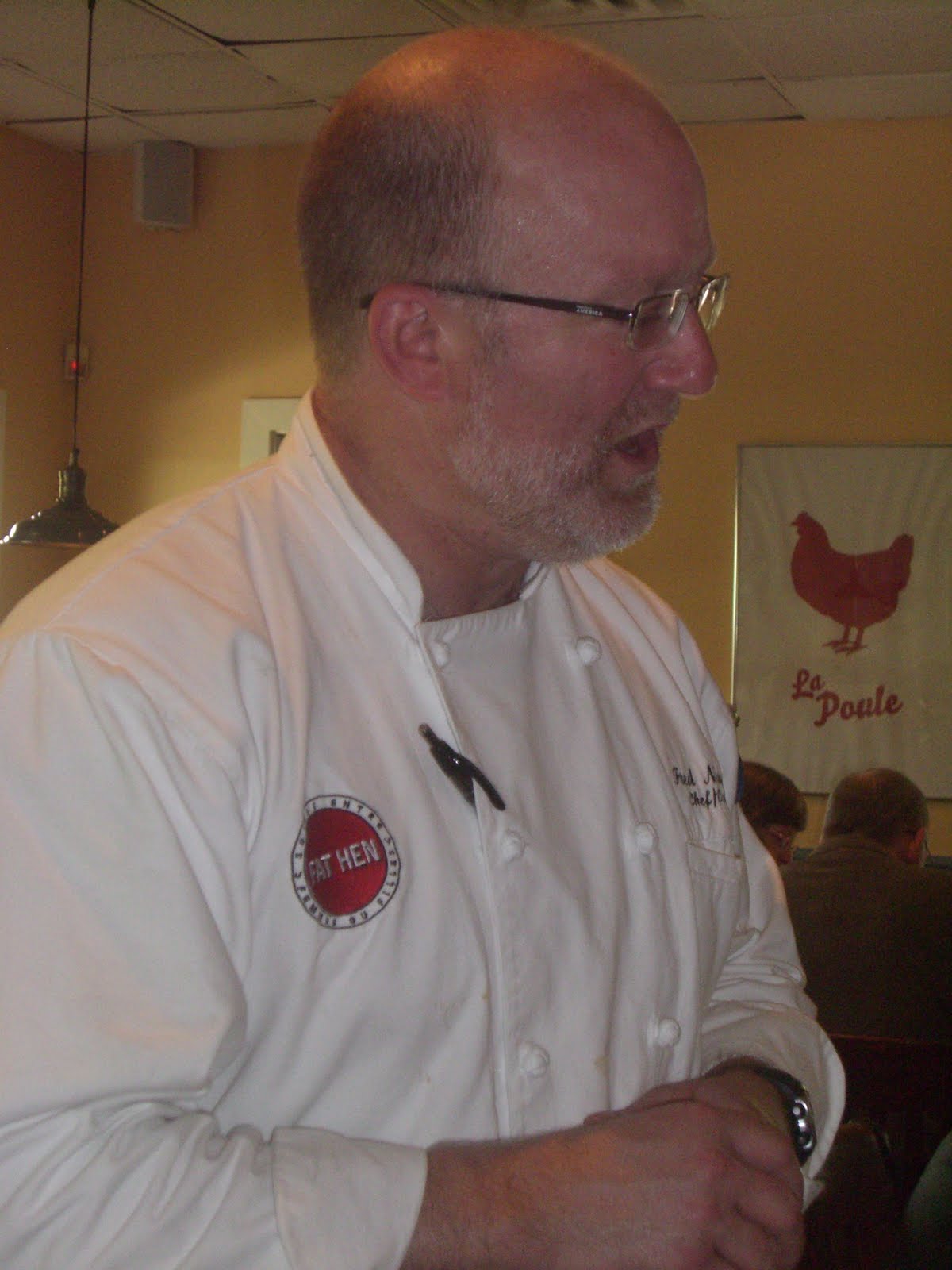
I was mystified when people were talking about “bald peanuts.” Turns out it’s “boiled peanuts,” where raw peanuts are boiled in the shell. The taste and texture is similar to a bean or lentil. A French Lowcountry restaurant, The Fat Hen, has boiled peanuts in its signature salad, along with roasted corn and butter beans. It was soooo delicious! 
 I think the Fat Hen's chef, Fred Neuville, prescribes to that popular theory that bacon makes everything better. Lots of his dishes, including collard greens and cole slaw were liberally laced with bacon. 
McCrady’s tavern was built by Madeira importer Edward McCrady in 1788.  When Washington toured the Southern States in 1791, he ate at McCrady’s. 
I had dinner there with my friend Cheramie Sonnier, assistant editor at the Baton Rouge Advocate. I loved the fennel soup, and that’s one dish I intend to replicate at home. 
But we were a little disappointed in the Chicken Gallantine and Strawberry Custard dessert from chef Sean Brock. Maybe our expectations were too high after hearing he was a James Beard award-winner. But, if it was good enough  for the President, by George, it’s jolly well good enough for me!
Cookbook author Nathalie DuPree invited some of us to visit her charming home in downtown Charleston. I got a kick out of her garden, where she's "planted" broken dishes. 


We saw the Angel Oak tree, on St. John's Island, a live oak that is estimated to be around 1,500 years old.

I'll be posting more about some of the seminars, people, and food from the conference. But for now, let me finish with my little song, "Nothin' could be finer than to be in Carolina in the morning!" 

Free Side Dishes at El Pollo Loco

The El Pollo Loco restaurant chain is offering three new side dishes: flame-grilled corn, sweet potato fries and sweet corn cake. You can try any of them for free with purchase of a drink and an online coupon http://www.elpolloloco.com/Coupons/FreePremiumSide.aspx.
And for a limited time, El Pollo Loco is offering a free large side dish with the purchase of any family meal.   

Monday, April 11, 2011

Save on Gas and Groceries

Smith’s Food & Drug Stores today announced a new “rewards” card fuel program, to save customers up to $1 per gallon when they gas up at any Smith’s location or participating Shell stations. 
Smith’s has had a food-and-fuel deal in place for the past few years.  Utah shoppers with a “rewards” card could get 5 cents, 10 cents, or 15 cents off per gallon of gasoline at Smith's fuel stations,  depending on the amount of groceries purchased. If you use a Kroger credit card, you could get an additional 5 cent discount. 
With the new program, customers choose whether to “cash in” their rewards points at the pump, or hold onto rewards points and save later through their personalized gold envelope rewards mailing at the end of each quarter.
No minimum purchase is required.  Each dollar spent will earn one point when using a rewards card at Smith’s and Smith’s Marketplace.  Fifty additional points are earned through prescription purchases.  Each 100 rewards points earned may now be redeemed as a savings of 10 cents per gallon at the pump up to $1 per gallon (maximum 35 gallons). Any rewards points not used toward fuel savings will be converted to a personalized rewards check mailed along with valuable coupons to loyal Smith’s customers each quarter.
As an incentive, any Smith’s customer using a rewards card for any single purchase made from April 13-19 will be automatically credited with 200 extra points, which may be redeemed as 20 cents per gallon in fuel savings or saved toward their quarterly rewards mailing. Customers may visit their “My Smith’s” page at www.smithsfoodanddrug.com to check their total rewards point status at any time.  Original Fresh Values cards will not be honored in fuel programs and should be converted to a rewards card to receive fuel and point certificate benefits. Rewards card questions may be directed to 1-800-576-4377.
It's no secret that gas and grocery prices are going up. If you already have a grocery shopping system to save money, great. If not, this might be something to try. 

Friday, April 8, 2011

Nothin' Could Be Finer .... Than Comforting Chicken Vegetable Soup


I've been humming "Nothin' Could Be Finer Than To Be in Carolina" most of the day.  This past week I spent several days in warm, sunny Charleston, South Carolina for the National Chicken Council's annual Food News Seminar. It's been really annoying to come back to snow and sleet, in April! We were sooooo done with winter weather back in January! 
So a big, comforting pot of chicken vegetable soup was in order yesterday.  This recipe comes together in just 30 minutes, giving me time yesterday afternoon to assemble a Barbie tricycle for my granddaughter Jayden's third birthday. I'm not very mechanically minded, so the bike took longer to assemble than the soup.
I prefer using homemade or canned chicken stock instead of the bouillon cubes and water, but the bouillon cubes are inexpensive.   
COMFORTING CHICKEN VEGETABLE SOUP
 2 chicken boneless, skinless breasts, or 1 breast and two boneless, skinless thighs, diced in 1-inch pieces (this is easier to do when slightly frozen)
1 tablespoon vegetable oil
1 cup thinly sliced celery, about 2 ribs
2 cups baby carrots, cut in half width-wise 
3 14-ounce cans chicken broth (or 5 cups water and 5 chicken bouillon cubes)
1/3 cup dried onion flakes (or 1 onion, peeled and chopped)
2 large potatoes, peeled and diced in 1-inch cubes (or 1 20-ounce package of Simply Potatoes fresh-cut potatoes, or 4 cups frozen diced hash browns)
1 teaspoon garlic powder
1 teaspoon dried thyme
1 bay leaf
1 14.5-ounce can diced tomatoes (or 1 12-ounce can V-8 juice)
1 teaspoon freshly ground pepper
1 cup corn kernels, canned or frozen
1 cup frozen peas
Options: 1 cup dried pasta (such as broken spaghetti, rotini or elbow macaroni), 1/2 cup chopped red or green pepper, 1 cup frozen green beans, 2 tablespoons chopped parsley
 Heat the oil in large stock pot while you’re dicing the chicken.  Then cook the chicken over medium-high heat until that it’s golden brown on all sides, about 5 minutes. Add the celery and carrots, water and bouillon cubes and bring soup to a gentle boil. Then peel and dice the potatoes. Add the potatoes, onion flakes, garlic, thyme, tomatoes or V-8 juice, pepper and corn.  Keep soup at a gentle boil for at least 20 more minutes, or until the vegetables and meat are tender. Taste and correct seasonings (you may want more garlic, more bouillon, thyme or pepper, depending on individual taste).
If you use pasta, add it about 10 minutes before serving. Add the peas during the last few minutes of cooking so they don't lose their bright color. Makes about about 8 to 10  1-1/2-cup servings.

Thursday, April 7, 2011

Death of a Chef

I was sorry to hear about the passing of Robert Barker, the chef at Salt Lake City’s Bambara restaurant from 2003-2007. He was just 44 years old when he died Saturday morning at his home in New Orleans.  
I’ve been in South Carolina the past few days (which will be the subject of another post tomorrow), and Bambara’s publicist Karen Boe passed along Robert’s obituary from his aunt, Robin, Blut.  
I interviewed Robert several times, and ate some of his New Orleans-inspired dishes while he was at Bambara. Most memorable is the time that he and some  other chefs donned pink tutus to publicize the Taste of the Nation fund-raiser!  Another time he shared a favorite lamb recipe using local Morgan Valley lamb (photo below is from that Deseret News story, showing Barker with Morgan Valley lamb owners Jamie and Linda Gillmor).  He packed a lot of cooking experience into the short years of his life.  He worked for celebrity chefs Wolfgang Puck and Emeril Lagasse, started his own restaurant, and was involved in a book honoring America’s best chefs. Here’s his obituary:
Robert Barker, a chef who took his New Orleans training and love of its food to Salt Lake City and restaurants across the country, died Saturday morning at his home in New Orleans, LA. He was 44.
"It was unexpected," said his mother, Robin Blut. “ But we believe it was his heart.”
The Houston-born chef was graduated from the Delgado Culinary Arts Apprenticeship Program in New Orleans, and continued his training at Arnaud’s restaurant in that city, beginning in 1986. Barker distinguished himself there, and in 1992 was hired by celebrated chef Wolfgang Puck, and moved to California. 
 “Robert was a passionate, talented cook and we will all miss him. The only thing I can think is that God probably needed a new chef who could not only make great pizza and wonderful fish dishes but also train the chefs in heaven,” Puck said, on learning of Barker’s death.
 In 1998, Barker returned to New Orleans as Executive Sous Chef at Emeril’s. In 2001, he started his own restaurant, DemiEpicurious, in Austin, TX. The restaurant specialized in Barker’s personal version of modern Southwest cuisine — with more than a little New Orleans stirred in. He believed in using local ingredients combined in new, clever ways, and although he and the restaurant got rave reviews, Barker was forced to close as the Gulf War broke out and business declined. From 2003 to 2007, Barker served as Executive Chef at Bambara in Salt Lake City, where he turned a 3.5 million dollar operation into a $5.2 operation, and in 2007, was named “Best Chef” by Salt Lake City Magazine.
 Returning once again to New Orleans, Barker worked with author Kit Wohl as Executive Chef and Culinary Director on The Best of the Best, an enormous book project (to be published in the autumn of 2011 by Chronicle Books), celebrating the 25th Anniversary of the James Beard Foundation, and America’s Outstanding Chefs. For the book, which profiles — and include recipes from —the greatest American chefs over a quarter of a century, Barker researched, assisted in chef interviews, tested their recipes, translating them to work equally well for the non-professional cook. The book, which highlights the philosophy and passion behind America’s greatest chefs’ paths to the kitchen, took Barker all over America, and then, finally, back home to New Orleans.
 “In the traditional chef’s training, you go from chef to chef to learn your craft,” author Kit Wohl said. "Robert came full circle.”
 In New Orleans, Barker also worked on a series of award-winning regional cookbooks, one of which was named a Cookbook of the Month selection by Gourmet magazine and another, The P&J Oyster Cookbook, was named Cookbook of the year, 2010, by New Orleans Magazine.
 “Robert embraced the brotherhood of chefs, including the commitment to bring along young chefs. He introduced them to professional traditions and standards — and he introduced them to New Orleans cooking,” said Shane Baird, Executive Sous Chef at Jean-Georges Vongerichten’s Deer Valley, Utah restaurant. “He was my chef.  He guided me. And there was a side of Chef that laughed easily and enjoyed life to its fullest.”
 “I knew Robert for years,” said journalist Linda Ellerbee, author of Take Big Bites: Adventures Around the World and Across the Table. “We were both from Houston. We both loved New Orleans. I watched him grow as a chef, ate his food, enjoyed his company, and admired the hell of the man. This is a tragedy for his family, and for all who loved him. In or out of a kitchen.”
 “Robert had a way of driving his kitchen to embrace the challenge of the moment and never compromise on quality, “said Michael Haimowitz, a close friend who worked with Robert as a line cook for Wolfgang Puck at the beginning of their careers. “ He was confident in his ability to cook at an exceptional level, command a kitchen, and inspire the crew. Just last month, he came to help me open a restaurant in New York, teaching the next generation of cooks about becoming a chef. The kitchen creates a lifelong bond.”
 Wes Marshall, reviewing Barker’s cooking and his restaurant, DemiEpicurious, for the Austin Chronicle, may have best summed up Barker’s work when he wrote, “Based on my experiences at Demi, the whole crew appears to subscribe to the following: “I’m not hard to please; I’m content with the very best.” -Fernand Point 1879-1955
 Barker is survived by his daughter Camille, his mother, Robin Blut, his step-father, Louis Blut, his brother Zev Blut, and sisters Michele Barker and Danielle Blut.

A memorial ceremony will take place Sunday, April 9, at 3:00 p.m. in the Rothko Chapel in Houston. The family requests that in lieu of flowers, donations in memory of Chef Robert Barker be sent to the Delgado Foundation for the Delgado Culinary Arts Program. Please mail check to the Delgado Foundation, 615 City Park Ave, New Orleans, LA 70119.

Wednesday, April 6, 2011

Chipotle's Wrap Up Contest


The past few weeks, Chipotle restaurants have been wrapping their burritos in gold foil to draw attention to its fresh, sustainably-raised ingredients. 

Now, Chipotle is giving customers a chance to win $10,000 in a “Wrap What You Love” contest.  Between now and May 11, they can visit chipotle.com/gold, and upload a picture of something they love wrapped in gold or silver foil. The best entry based on “love” votes will receive $10,000. For each “love” vote, Chipotle will donate $1 to FamilyFarmed.org (up to $150,000) to support programs that help family farmers bring more food to market.

I've noticed that most food contests -- even cooking contests -- are adding some kind of online voting. If you've got a strong social media base to drum up votes, that $10,000 could be yours.