Showing posts with label Charleston. Show all posts

Tuesday, July 5, 2011

GOING NUTS OVER WALNUTS

Spinach and walnut salad                                        Photo by Valerie Phillips

I like all kind of nuts, but walnuts are probably my least favorite.
I guess that's because they are usually embedded in a recipe such as banana bread or brownies. I prefer nuts that have that "party food" vibe going on, such as cashews, almonds or even peanuts.
But I'm changing my opinion since finding out that walnuts are the only nuts that are high in that all-important omega-3 fat. While I was in Charleston at the Food News Seminar in April, I met Kaley Todd, a spokesman for California Walnuts.  She told me that walnuts contain 2.5 grams of alpha-linolenic acid (an omega-3 fatty acid) per ounce — way more than any other type of nut.  So, I wrote a column about them in this week's Deseret News .
Omega-3 fats are thought to reduce the risk of heart disease and stroke, reduce symptoms of depression, attention deficit hyperactivity disorder, joint pain and rheumatoid problems.
Some research links omega-3s with boosting the immune system to help protect from illnesses such as Alzheimer's disease.
Other good sources of omega-3s are coldwater fish, such as salmon, and flax seed.
Due to the strength of clinical studies supporting walnuts and cardiovascular health, the U.S. Food and Drug Administration approved a health claim for walnuts in 2004, that "eating 1.5 ounces of walnuts per day, as part of a low saturated fat and low-cholesterol diet, and not resulting in increased caloric intake, may reduce the risk of coronary heart disease."
The catch is the "not resulting in increased caloric intake." Because whether it's "good" fat or "bad" fat, walnuts still contain lots of fat. An ounce of walnuts, which is 1/4 cup of shelled halves or pieces, contains 190 calories; 160 of those calories comes from fat.
Todd said the point is not to ADD nuts to your existing diet, but to SUBSTITUTE them for some of the high-fat stuff you're already eating.
Maybe it's that handful of potato chips, or an extra slice of dessert. That way, you're still taking in the same amount of calories, but they're healthier calories.  (Yes, I know, it's easier said than done. But, it's a thought....) 
And you don't have to eat a whole lot of walnuts at a time for them to do you some good.
They're expensive, but a little can go a long way. You can sprinkle chopped walnuts on your cereal. I like sprinkling them on a salad. When I sauté asparagus spears, I like to toss in a handful of chopped nuts as well.
I've made fragrant pesto with walnuts instead of the usual pine nuts, which are more pricey. 
Use the fresh basil growing in your summer garden; or buy a big bunch of basil at a farmers market. 

Here's a recipe for a walnut-based pesto, adapted from "The Silver Palate Cookbook," by Julee Rosso & Sheila Lukins.The pesto is good as a dip, or tossed into pasta or soup (especially minestrone). And you can freeze it to use later.

Basic Pesto
2 cups fresh basil leaves
4 medium cloves garlic, chopped
1 cup walnuts
1 cup olive oil
1 cup grated Parmesan cheese
¼ cup grated Romano cheese (optional)
Salt and pepper to taste
Process basil, garlic, walnuts in a food processor. With the machine running, add olive oil. Add cheeses, a liberal dose of salt and a thin grinding of pepper.
Remove to a bowl and cover until ready to use.
Or, divide into small, plastic containers and freeze.
— adapted from"The Silver Palate Cookbook," by Julee Rosso & Sheila Lukins

Sunday, June 5, 2011

COUNTRY CAPTAIN CHICKEN: A TALE OF TWO CITIES AND ONE PRESIDENT

COUNTRY CAPTAIN CHICKEN

Looking for a new way to do chicken? Although it's not well-known in Utah, Country Captain Chicken is actually a very old recipe that carries some Southern lore. 


It's claimed by both Charleston, S.C. and Savannah, Ga. 


President Franklin Roosevelt and General George Patton were supposedly both fans of it. 


It's found in numerous cookbooks from the Lowcountry (Charleston and South Carolina's Sea Islands), and from older times when recipes were referred to as "receipts."
 
While I was in Charleston in April, I learned about this dish from cookbook authors Matt & Ted Lee, whose Country Captain Chicken beat Bobby Flay’s in a Food Network throwdown. The Lee brothers did a “lowcountry cooking” demonstration at the Food News Seminar, sponsored by the National Chicken Council.

Matt & Ted Lee's cooking demonstration in Charleston, S.C.

The Lee Brothers’ recipe calls for chicken thighs, but other recipes use chicken breasts. The chicken is browned in bacon fat, stewed in a tomato-y sauce, and served over rice. 


But reading over the recipe, it sounds more like something from India than a Deep South staple. Curry powder? Garam masala? Ginger? Currants? What's up with that?

Since Charleston and Savannah are ports, the cuisines of each city benefited from their access to the spices that arrived aboard ships that also hauled rum, molasses, tropical fruit and, unfortunately, slaves.


There are several stories about the dish’s origin; one is that is a British sea captain who had been stationed in Bengali, India shared the recipe with friends in the port city of Charleston (or Savannah, depending on who’s telling the story). The dish was named for the officers in India called “Country Captains.”

Franklin D. Roosevelt was said to become a fan of the dish after tasting it in Warm Springs, Ga., while taking spa treatments for his paralysis.  Supposedly Gen. George S. Patton tried the dish while visiting President Roosevelt at Warm Springs, and it became a favorite for him as well. 

COUNTRY CAPTAIN CHICKEN

1/2 cup chicken broth

1/2 cup dried currants or raisins

1 tablespoon curry powder

1 tablespoon garam masala

 1 1/2 teaspoon salt

1/2 teaspoon black pepper

1/4 pound bacon

12 chicken thighs, skin on, trimmed of excess skin and fat

1 large dried chile, split, seeds removed

2 1/3 cups carrots, peeled and sliced into 1/4-inch thick rounds

2 cups yellow bell peppers, diced

2 cups yellow onions, diced

3 cloves garlic, unpeeled

1 28-ounce can crushed tomatoes, with juice

2 tablespoons grated fresh ginger

4 cups cooked white rice

2/3 cup slivered, chopped, toasted almonds

1/2 cup chopped fresh flat-leaf parsley

Preheat the oven to 350 degrees. In small saucepan over high heat, bring broth to a boil. Place currants in a small bowl and pour enough broth over them to cover; let stand. In another small bowl, combine the curry powder, garam masala, salt and pepper.

In a large cast-iron pot or Dutch oven, cook bacon until firm, about 5 minutes. Transfer bacon to a small bowl and reserve.

Pour off all but 2 tablespoons of fat from the pot, reserving the excess fat. Place chicken in pot and cook over medium-high heat, until golden brown, about 5 minutes per side. (Add the reserved bacon fat, 1 teaspoon at a time, if the pot becomes too dry.)  Remove the chicken and reserve in a medium bowl. 

Add 2 teaspoons reserved bacon fat to the pot. Add chile and toast in the fat, about 30 seconds per side, until fragrant. Add carrots, bell peppers, onions and garlic to the pot; cook until slightly softened about 6 minutes. Add tomatoes, spice mixture, ginger and currants in broth. Reduce the heat to medium-low, and simmer until the tomatoes have cooked down to a puree and the sauce has thickened around the vegetables, about 8 minutes.

Place chicken thighs gently in the vegetable sauce so the skin side faces up and is above the surface of the gravy. Tent the pot loosely with foil and transfer to the middle rack of the oven. Bake 20 minutes, until the country captain resembles a roiling stew around the chicken thighs, about 20 minutes. Remove foil and bake until the sauce has thickened further and the chicken skin is just beginning to crisp, about 15 minutes more.

Remove from the oven, skim any excess fat from the surface, and season to taste with salt and pepper. With tongs, transfer 3 thighs to each of 4 wide, deep bowls filled with 1 cup hot white rice. Spoon sauce over chicken and rice; garnish with reserved bacon, almonds, and parsley. Discard the chile.

— Matt and Ted Lee, The Lee Bros. Southern Cookbook (W. W. Norton & Co, 2006) 

Wednesday, May 25, 2011

FENNEL BISQUE, LOW-FAT AND LOVIN' IT


Fennel Soup at McCrady's in Charleston, garnished with shrimp, croutons and olive oil drizzle.
While in Charleston last month, I had dinner at the historic tavern-turned-restaurant, McCrady’s. It was built by Madeira importer Edward McCrady in 1788.  When George Washington toured the Southern States in 1791, he ate at McCrady’s. (And if it was good enough for a president, by George, it’s good enough for me.) 

I was intrigued with the fennel soup that was one of the starter courses,  and wanted to replicate it when I came home. It was cream-colored and smooth, with a mellow licorice flavor.  Chef, Sean Brock, a James Beard Award-winner, had garnished each bowl with two plump fresh-caught shrimp, the feathery fronds and croutons. It reminded me of the garlic bisque I’ve eaten at Emeril’s restaurant, NOLA.  Like garlic bulbs, fennel has a strong flavor that mellows with cooking and cream.  
I couldn’t find a recipe on the restaurant’s Web site or that of chef Brock. So I experimented and came up with my own recipe. It was the first time I’d done much cooking with fresh fennel, which resembles celery or leeks in size and shape.  It has a white bulb at the bottom, green stems and feathery green fronds on the ends. The bulb is the main part that you cook with.
I used the same technique for a lot of other creamy veggie soups: saute and simmer the veggies, then puree them so that they’re smooth and thickened. And, they often use some type of cream. I used fat-free half-and-half. The soup was pleasantly creamy but probably lower in fat the the McCrady’s version.
The recipe took about a half-hour to make, from start to finish. 
FENNEL BISQUE
3 bulbs of fennel, with stalks and feathery green tops (about 2-3 pounds)
2 tablespoons butter
1 yellow onion, peeled and sliced
1 clove garlic, minced
2 cans (about 4 cups) chicken stock 
1  cup half-and-half
Salt and freshly ground black pepper
Heat butter in a soup pot over low heat. Remove the green fronds from the fennel stalks and reserve. Coarsely slice the fennel bulbs and stalks. Slice the onion and garlic.


Turn the heat up to medium-high. When butter begins sizzling, add the onions and fennel and cook, stirring, about 5 minutes, until they become slightly softened. Stir to keep them from burning. Add the garlic and chicken stock and increase the heat to high. Bring soup to a gentle boil and cook, covered, until fennel is tender, about 10 minutes.


Puree the soup, in batches, in a blender until very smooth. If a very smooth soup is desired, strain through a strainer into a serving pot or bowl.  Add the half-and-half and season with salt and pepper. Serve with some of the fennel fronds and dots of olive oil as a garnish. Makes about 6 1-cup servings.

Tuesday, April 12, 2011

Culinary Expedition in Charleston


Today marks 150 years since the opening shots of the Civil War were fired in the harbor of Charleston, S.C.  So it was a cool thing to get a chance to be in Charleston last week for the National Chicken Council’s Food News Seminar. It offered great opportunities to learn more about the culture and cuisine, known as “Lowcountry.” 

Seminar topics ranged from Gullah culture and cuisine, nutrition in walnuts, the chocolate-milk-in-schools debate, the rising prices of food, changes in the perishable aisles of your grocery store, and the controversial practice of “plumping” chicken with salt water.  
We watched a cooking demo on Lowcountry cuisine by Matt & Ted Lee, whose Country Captain Chicken beat Bobby Flay’s in a Food Network throwdown. 
We also visited the the Dock Street Theater, first opened in 1736. 


We visited America’s only tea plantation, the Charleston Classics Tea Plantation on Wadmalaw Island. We also went to the Firely Distillery (and no, I didn't participate in the tastings at either of these places, in case you're all wondering!)  

The  barrier islands of South Carolina are home to the Gullah, descendants of African-American slaves. Their isolation allowed them to preserve many African customs such as basket weaving, rice cultivation and shrimp fishing.
Charlotte Jenkins, owner of Gullah Cuisine restaurant, cooked a fabulous lunch of  shrimp with gravy over grits, Gullah jerk chicken (mildly seasoned than Caribbean jerk), deviled crab, okra gumbo, collard greens, and cornbread. There were three different kinds of rice — Okra perlou (a Lowcountry term for pilaf), red rice (with a little tomato-y base) and Gullah rice (flavored with chicken, sausage and shrimp). I loved the pecan squares (similar to pecan pie) for dessert. 

We were treated to a performance by Gullah gospel singers.

Local sweetgrass weaver Henrietta Snype showed us the tradition that’s been handed down through her family for generations. 
As one would expect at a chicken industry meeting, the menus included fried chicken, barbecued chicken, grilled chicken, poached chicken, smoked chicken, chicken galatine, chicken mousse appetizers, and chicken sausage. I especially enjoyed the locally caught shrimp and crab. Rice, grits and collard greens were also popular.
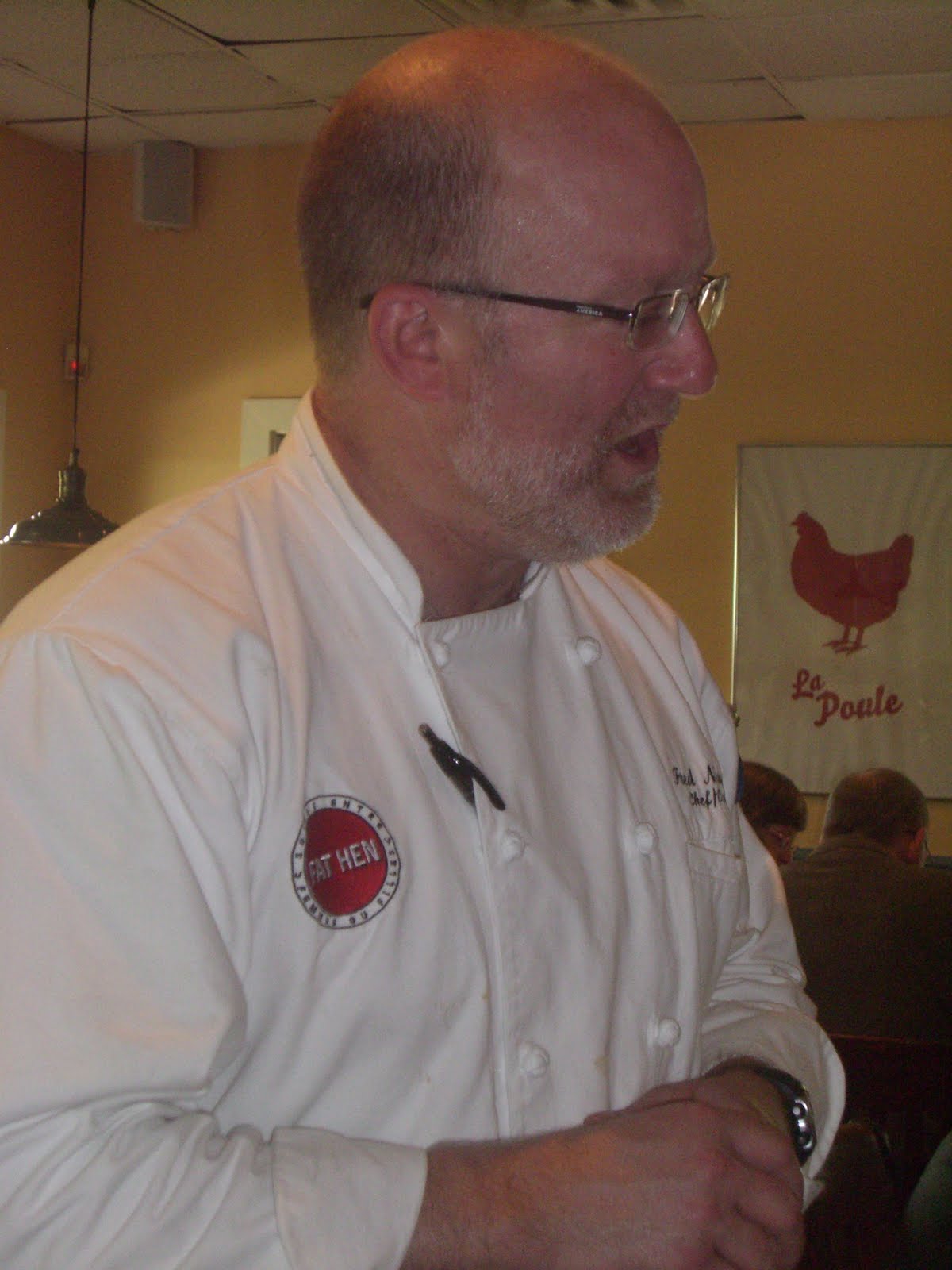
I was mystified when people were talking about “bald peanuts.” Turns out it’s “boiled peanuts,” where raw peanuts are boiled in the shell. The taste and texture is similar to a bean or lentil. A French Lowcountry restaurant, The Fat Hen, has boiled peanuts in its signature salad, along with roasted corn and butter beans. It was soooo delicious! 
 I think the Fat Hen's chef, Fred Neuville, prescribes to that popular theory that bacon makes everything better. Lots of his dishes, including collard greens and cole slaw were liberally laced with bacon. 
McCrady’s tavern was built by Madeira importer Edward McCrady in 1788.  When Washington toured the Southern States in 1791, he ate at McCrady’s. 
I had dinner there with my friend Cheramie Sonnier, assistant editor at the Baton Rouge Advocate. I loved the fennel soup, and that’s one dish I intend to replicate at home. 
But we were a little disappointed in the Chicken Gallantine and Strawberry Custard dessert from chef Sean Brock. Maybe our expectations were too high after hearing he was a James Beard award-winner. But, if it was good enough  for the President, by George, it’s jolly well good enough for me!
Cookbook author Nathalie DuPree invited some of us to visit her charming home in downtown Charleston. I got a kick out of her garden, where she's "planted" broken dishes. 


We saw the Angel Oak tree, on St. John's Island, a live oak that is estimated to be around 1,500 years old.

I'll be posting more about some of the seminars, people, and food from the conference. But for now, let me finish with my little song, "Nothin' could be finer than to be in Carolina in the morning!"