Showing posts with label Nutrition. Show all posts

Tuesday, February 21, 2012

Diabetes Expo Takes Place Feb. 25

 The Diabetes Expo, sponsored by the American Diabetes Association, takes place this Saturday, Feb. 25 at the South Towne Expo Center.    Thousands of Utahns show up each year to see a variety of exhibitors including Harmons, Gold’s Gym and Optimum Clinical Research, an industry leader in diabetes research. 

Admission to the exposition is free and includes health screenings, cooking demonstrations, product and service exhibitors, and presentations from leading experts talking about diabetes management and prevention. 

Admission to the exposition is free and includes health screenings, cooking demonstrations, product and service exhibitors, and presentations from leading experts talking about diabetes management and prevention. 


Friday, February 3, 2012

COOKBOOK GIVEAWAY: "Tipping The Scales In Your Favor"

We have a winner of "The Cake Mix Doctor Bakes Gluten-Free."  I put the names (including Anonymous) into a bowl, shook it up and drew one out -- Julie Bakker!

Thanks for playing, everyone.

Next on the giveaway is "Tipping The Scales in Your Favor: Small Steps That Make a Big Difference in Your Health, Weight and Happiness," by Dian Thomas.

 For years, Dian Thomas was a regular on NBC's "Today Show." Her 'Roughing It Easy" book was a New York Times Bestseller, and she was sought after for speaking engagements, TV appearances, cooking demonstrations, and so on.

But over the years, a hectic lifestyle filled with lots of food wreaked havoc.  in 2003, she tipped the scales at 326 pounds. The book tells how she regained her health by losing over 125 pounds.

 It is packed with information on eating healthy, finding exercise that you love to do (so you'll do it!), and de-stressing.  The book explores a lot of the mind-body connection; in setting yourself up for success, in loving yourself, and setting habits. There are lots of tips and recipes as well.

Another cool thing -- Dian lives right here in Utah!

If you want to be in the drawing for this book, leave a comment on this blog post! I'll be drawing out the winner next Friday.

Wednesday, February 1, 2012

Paula Deen's Diabetes Issue

Why are people so angry that Paula Deen has Type 2 diabetes? In my column in today's Deseret News, I wrote that I don't remember such a big reaction over a celebrity's outing of a disease since Rock Hudson announced that he was dying of AIDS, or maybe Magic Johnson's revelation that he was HIV positive.
When people found out actor Michael J. Fox had Parkinson's disease, there was a rush of support and sympathy. But in this case,  angry diabetics are calling the Food Network's Queen of Southern Cuisine a hypocrite.
Deen has never claimed her Food Network show's cuisine — built on butter, bacon and mayo — is health food. When questioned about it over the years, she has always talked about "moderation."
But at the same time she revealed her Type II diabetes, she announced her ad campaign with diabetes drug-maker Novo Nordisk. From the public's point of view, she's cashing in on her illness by endorsing a drug, when she could instead become a role model for reformed eating habits.
Also, Deen was diagnosed with diabetes three years ago — but still kept cookin' up her Southern specialties such as fried chicken and Gooey Butter Cake on her show, "Paula's Best Dishes."
Did she wait until the ink was signed on a lucrative contract before going public?
In fact, my column has already sparked some emails to me. One writer told me she works with diabetic patients, and that it is still a ravaging disease, with people losing their legs, eyes and other body parts.  In my column, I mentioned that my Grandma Sagers died from diabetes complications when I was very young.  One of my earliest childhood memories is of her in her wheelchair  because her legs were amputated.
Obviously we've learned a lot since then, and it's great that modern medicine has come up with more treatments so that diabetes is more manageable. However, we've also learned that   lifestyle changes, such as diet and exercise, make a huge difference.
The PR blunder seems pretty obvious. In fact, Paula Deen's publicist, Nancy Assuncao, reportedly quit because she disagreed with the drug endorsement. But Assuncao surely knew of Deen's diabetes within the past three years.  Did it ever occur to her to advise Paula to start lightening up her food on the show in order to deflect a lot of future criticism?
Son Bobby Deen just launched a Food Network series, "Not My Mama's Meals," where he lightens up some of her famous dishes. Although it's a step in the right direction, it seems timed to capitalize on Paula's condition.
After the firestorm hit, Paula Deen announced that her family will donate a portion of the money from the Novo Nordisk to the American Diabetes Association. And there's been some positive talk that she is building awareness of the disease.
If you're wondering why Deen doesn't use this moment to market something healthy, like vegetables …… well, she's been there, done that. Last November, Paula Deen launched  “Simply Fresh” side dishes. The fresh veggies came in microwavable bags, with her smiling face on the package. Unfortunately, these veggies were gussied up Paula-style. The broccoli had a creamy herb butter sauce, the green beans were coated with butter and bacon, and the vegetable medley swam in an asiago cheese sauce.
Sure, if all you got in the bag was plain vegetables, what would be the point in paying $3.99 for a bag with four servings? But drowning veggies in butter, cheese and bacon is nothing new. It would have shown a lot more innovation to punch up the flavor with herbs, or a low-fat sauce.
The Physicians for Responsible Medicine (a non-profit group that advocates a vegan diet) …sent Deen a letter inviting her to try its noncommercial 21-Day Kickstart program, featuring lowfat vegan cuisine. The group sent out a press release claiming that their low-fat vegan diet controls blood glucose more effectively than a standard diabetes diet, and may be more effective than diabetes drugs.

I've never met Paula Deen, but her folksy charm seems sincere. I've never heard anything negative about her from my food journalist friends who have had plenty to say about the divas they've dealt with.  
And I don't blame my personal weight issues on Deen's penchant for Gooey Butter Cakes and Southern fried chicken. Plenty of other celebrity chefs offer up high-fat recipes. "Barefoot Contessa" Ina Garten's Brownie Pudding contains a half-pound of butter, split among just six servings. And I can't sit through an episode of Guy Fierri's "Diners, Drive-Ins and Dives" without the feeling that my arteries are hardening.
Deen is certainly not the first TV cook to capitalize on products and endorsements. But she's taken it to a new level. Although her celebrity status came later in her life, she's made up for lost time. She’s not only come out with cookbooks and magazines, but day planners, recipe cards and stationery. She’s not only done a line of pots and pans, but a set of kids’ cooking utensils.  She not only published her own biography, but husband Michael Groover did “My Delicious Life With Paula Deen” as well.
Fans can buy Paula Deen-endorsed seasoning blends, coconut cake, pecan pies, kitchen equipment, gift tags, mattresses, furniture, rugs, and mugs, or eat at a Paula Deen Buffet.
She’s been a spokesperson for Philadelphia Cream Cheese, Smithfield Hams and B.Lloyds nuts. 
And now, she can add diabetes drugs to the lucrative list.

Tuesday, January 10, 2012

RESTAURANTS THAT OFFER HEALTHY MEALS


Restaurant dining can be hazardous to your waistline. It's hard to resist the "splurge" mentality; there's that unconscious thought that, "I'm eating out, so I'm going to forget about the calories." And, the reason that a lot of the dishes taste so good is because they contain lots of butter, cream, oil, salt and sugar. In fact, a new Food Network series, called "Fat Chef," explores the struggles of overweight chefs,  underscoring the idea that there's a lot of calories coming out of those kitchens.
Pinon Cafe offers a daily healthy take-out meal.
But more restaurants are also offering some healthy choices that are filling and flavorful besides the old standby grilled chicken salad. In my column that ran in today's Deseret News, I listed the following options:
On the chain restaurant front, Applebee's  recently updated its menu to offer five entrees that are under 550 calories. They include a Roasted Garlic 7-ounce Sirloin served with herbed potatoes and a grilled portobello mushroom cap, Sizzling Chili Lime Chicken with Asian-style vegetables,
Sizzling Asian Shrimp & Broccoli, Signature Sirloin with Garlic Herb Shrimp and Grilled Dijon Chicken & Portobellos. According to an Applebee's press release, the Signature Sirloin with Garlic Herb Shrimp was Applebee's top seller among all entrees during the first two months of 2011, the first time in Applebee's history that a lower calorie entree was the best-selling independent menu item.
On the local front, Pinon Café & Market at 2095 E, 1300 South offers a "Healthy Meal" takeout option. The menu, which changes daily, can be found on the café's website at http://pinonmarket.com/menus/healthy-meals#healthy. They include entrees such as Salmon Cake with Cucumber Apple Slaw and Herbed Brown Rice, Roasted Vegetable Napoleon with Pan-Seared Chicken Breast, Pork Tenderloin Medallions with Mashed Sweet Potatoes, Apricot Chutney and Steamed Vegetables, or Seared White Fish in Fennel Saffron Broth with Seasonal Vegetables.
Café owner and chef Victoria Topham said the meals contain a healthy ratio of balance of carbs, proteins and fats. Fats and sugars are used sparingly, and carbs are whole-grain instead of white flour. Flavor is added through herbs, spices, balsamic vinegar, vegetables and so on.
She said she's found through her own experience that it's important to eat the right kinds of foods to fuel the body's metabolism and burn calories.
"The answer for women has always been to eat less and exercise more, and when you are younger, that works," said Topham. "But when you are older it matters what you eat as well. You can eat nothing but salad and still not change your body. You need to eat a combination of the right kinds of foods."
The price is $28 for two adult meals, or $15 for one adult meal. She offers discounts for ordering multiple meals. The meals are ordered in advance by email or phone so that they can be made up fresh and picked up between 5-7 p.m.. Similar menu items are available in the café's display case for walk-in customers, but they may vary.
"A lot of processed food tastes good because it has a lot of sugar and oil in it," she said. "But we are coming up with real, fresh food that is satisfying and pretty healthy."
For several months, Log Haven's chef Dave Jones has offered a three-course "Low Cal-High Impact Special" under 700 calories. It is also gluten-free, according to the restaurant's spokesperson Lesley Christoph.  Currently offered is a first course salad of wild arugula, avocado, quinoa, pine nuts, Meyer lemon and California olive oil; and an entrée of Grilled Paillard of Local Turkey served with a cassoulette of barley, butternut squash, chard, tasso, Slide Ridge Honey and local cider/mustard sauce. Dessert is Roasted Pineapple Sorbet with Coconut Water Granita and fresh mango. Price is $36, and this special will run until the end of February.
Oasis Café,151 S. 500 East, last week began offering a $25 three-course dinner special to help guests to eat "responsibly."  The menu changes nightly, but could include a mixed green salad or the restaurant's signature Tomato Fennel Soup for the first course; and entrees such as Pan-Roasted Scallops on Purple Sticky Rice with Wasabi Oil or Sauteed Tiger Prawns over Corn Risotto with Brussels Sprouts. Dessert could be Port Wine Poached Pear or a choice of fresh-made fruit sorbet.
So, it IS possible to eat out and not jeopardize your diet.  But there's no guarantee that you won't jeopardize your wallet.

Monday, October 31, 2011

A 2-Minute Break To Protect Yourself From Cancer


The American Institute  for Cancer Research says that inactivity is responsible for almost 100,000 cancer cases in the U.S. every year.  So as you read this blog, if you realize that you’ve been sitting in front of your computer for an hour, get up and take a one-to two-minute “activity break” to reduce your cancer risk.  (But finish reading this post first!  I’ll be brief!)

In conjunction with its Annual Research Conference on Food, Nutrition, Physical Activity and Cancer in Washington, AICR will hold a news conference on Thursday where experts will present new, evidence-based estimates that inactivity is responsible for almost 100,000 cancer cases in the U.S. every year. In response, AICR will also call on adult Americans to take 1-2 minute activity breaks every hour to reduce their cancer risk.

Christine Friedenreich, Ph.D., Senior Research Epidemiologist Associate, Alberta Health Services-Cancer Care in Canada, will summarize new evidence of the protective link between physical activity and certain cancers.


Neville Owen, Ph.D., Director of Behavioral Epidemiology at Australia's Baker IDI Heart and Diabetes Institute, will present research from the emerging field of sedentary behavior, including new findings on what happens in the body during prolonged periods of sitting.  (Yikes! this CAN’T be good!)

See you in a couple of minutes!


Tuesday, July 26, 2011

MCDONALDS: HEALTHIER HAPPY MEALS


Happy Meals are getting healthier. McDonald’s today announced a plan called “Commitments to Offer Improved Nutrition Choices.” One major change is that McDonald's will automatically include BOTH low-fat apple slices and a smaller serving of french fries in its Happy Meals. And on request, you can get two apple slice packs instead of the fries. Beverage choices include fat-free chocolate milk and 1 percent low-fat milk. 


Actually, McDonald's has offered apples as a choice in Happy Meals since 2004; but apples are chosen only 11 percent of the time. By making them a routine part of the meal, perhaps people will develop a habit of eating them.  (I have to wonder how many people will just  toss them? You can lead people to the healthy food, but you can't force them to eat it.)


Also, the company pledged to reduce added sugars, saturated fat and calories through "varied portion sizes, reformulations and innovations."  I hope this doesn't mean that they will cut down on fat and calories simply by cutting the portion size. 


The McDonald's press release stated that the company has already reduced sodium by 10 percent in the majority of its national chicken menu offerings – most recently Chicken McNuggets. Sodium reductions will continue across the menu in accordance with the Company’s 2015 commitments.  


 In 2012, McDonald’s will also roll out nutrition messages in 100 percent of its national kids’ communications, including merchandising, advertising, digital and the Happy Meal packaging. McDonald’s will also provide funding for grass roots community nutrition awareness programs.

McDonald’s will expand new in-restaurant, website and mobile communications, and marketing vehicles making access to this information even easier. To begin, McDonald’s is now making available its first mobile app so customers can access nutrition information on-the-go.


I can't fault McDonald's for the country's weight problems.  For quite a few years, the chain has offered salads, apples, yogurt parfaits and so on. The choices are there; but it's up to people to make them.  I was around when the McLean Deluxe was introduced, and it was discontinued due to poor sales.  


One complaint I've heard is that the "healthy" food usually costs a lot more than the burgers, fries and chicken McNuggets.  That's true if you're comparing a salad to the dollar menu. But when you start getting into the big specialty  burgers, such as the Big Macs, Angus Burgers, or the Double Quarter Pounder, you could easily spend more on a combo meal than if you'd bought a salad. 


I know, maybe you don't really WANT a salad. But I'm just sayin'.


Friday, July 22, 2011

KETTLE BRAND'S NEW REDUCED-FAT CHIPS

I've mentioned before in this blog that I'm a fan of Kettle Baked Chips.  I think they are the best low-fat potato chip out there (isn't that kind of an oxymoron; a potato chip that's low-fat?)  I like them because they are real potato slices with none of the pre-fab texture of other baked brands.  They have 65 percent less fat that regular potato chips — three grams of fat, two grams of fiber and 120 calories per serving. The only problem is that old "betcha can't eat just one" saying. Hard to stop until the whole bag is gone. I'd be addicted, except they sell for around $3.49 per 4-ounce bag. I can't afford them except as an occasional treat.


Now Kettle has come out with a new line of reduced-fat chips, a happy medium between their thick, crunchy regular chips, and the Baked style. I tried a sample of the new chips, which boast 40 percent less fat than regular. 


To me, these reduced-fat chips taste nearly identical to the regular version — very fatty and indulgent.  They're 130 calories per serving, with 6 grams of fat. The Sea Salt flavor is already on grocery shelves; Salt & Fresh Ground Pepper and Sea Salt & Vinegar Krinkle Cut will be out in August. The suggested retail is $3.49 per 8-ounce bag, which makes them half the price of the baked line. 


I still like the baked line of chips better. I eat regular chips so rarely that I've become accustomed to the taste and texture of a less greasy chip. But if you already eat regular chips often, and want to painlessly cut back on the fat, this would be the way to do it. 

Monday, July 18, 2011

CANCER SURVIVAL COOKING CLASS


Can cooking help you survive cancer?

A Cancer Prevention and Survival Cooking Course takes place Saturday, July 30  4:30 to 6:30 p.m. at Thanksgiving Point, 3003 N. Thanksgiving Way, Lehi.

The free class is sponsored by The Cancer Project. Register at http://www.thanksgivingpoint.eventbrite.com 

The Cancer Project is a national nonprofit that promotes a low-fat vegetarian diet. Fruits, vegetables, and whole grains are naturally low in fat, full of fiber, and filled with cancer-fighting antioxidants and phytochemicals. Fatty foods and added fats and oils, particularly saturated fats,  have been linked to an increased risk of breast, colon, and prostate cancer.

The Cancer Project is a program of the Physicians Committee for Responsible Medicine. 

CHOCOLATE MILK: THE OFFICIAL UTAH HIGH SCHOOL SPORTS DRINK


Chocolate milk has now become "the official beverage" of the Utah High School Activities Association, which oversees high school athletics across the state, according to a press release from the Dairy Council of Utah/Nevada.


Local milk processors will provide chocolate milk at championship events throughout the state.

Last year when I did a story for the Deseret News about the eating and nutritional habits of BYU and U of U football players, the team nutritionists said that chocolate milk provides a good ratio of carbs, protein and fat to help your muscles recover from a tough workout.  

Yet chocolate milk is not without some controversy, since some school districts have stopped serving flavored milk in their cafeterias due to activists' complaints it contains too much sugar. But which is best, a little sugar helping the nutrients go down, or not drinking any milk at all?

From my Deseret News story, I found that the  BYU team is given a special protein shake after workouts that contains Greek yogurt (which has a higher protein content than regular yogurt), powdered milk, fresh juice, strawberries and bananas. Wayne Griffin of the campus' Legends Grill which makes the shake, said they got the basics for their shake when they visited the Olympic training facility in Colorado Springs.  "It offers calcium, potassium, carbohydrates and protein, and they consume it within 30 minutes of a workout to speed recovery."

When my son, Eric, played  football at Davis High School, he would take several shelf-stable cartons of chocolate milk with him in his backpack, along with several PB&J sandwiches. I would also cut up watermelon for an after-practice snack.  He and a couple of his friends could eat a large watermelon in one sitting. When I interviewed sports nutritionists for a story a few years later, I found out that these were all good post-workout foods. Some of them told me you don't need to spend a lot of money on protein powders, sports drinks and muscle shakes, because the "real food" such as PB & J sandwiches, fruit, yogurt and yes, chocolate milk, can give them the nutrition they need. 

Wednesday, July 6, 2011

IDAHO GOVERNOR: THIS SPUD'S FOR YOU


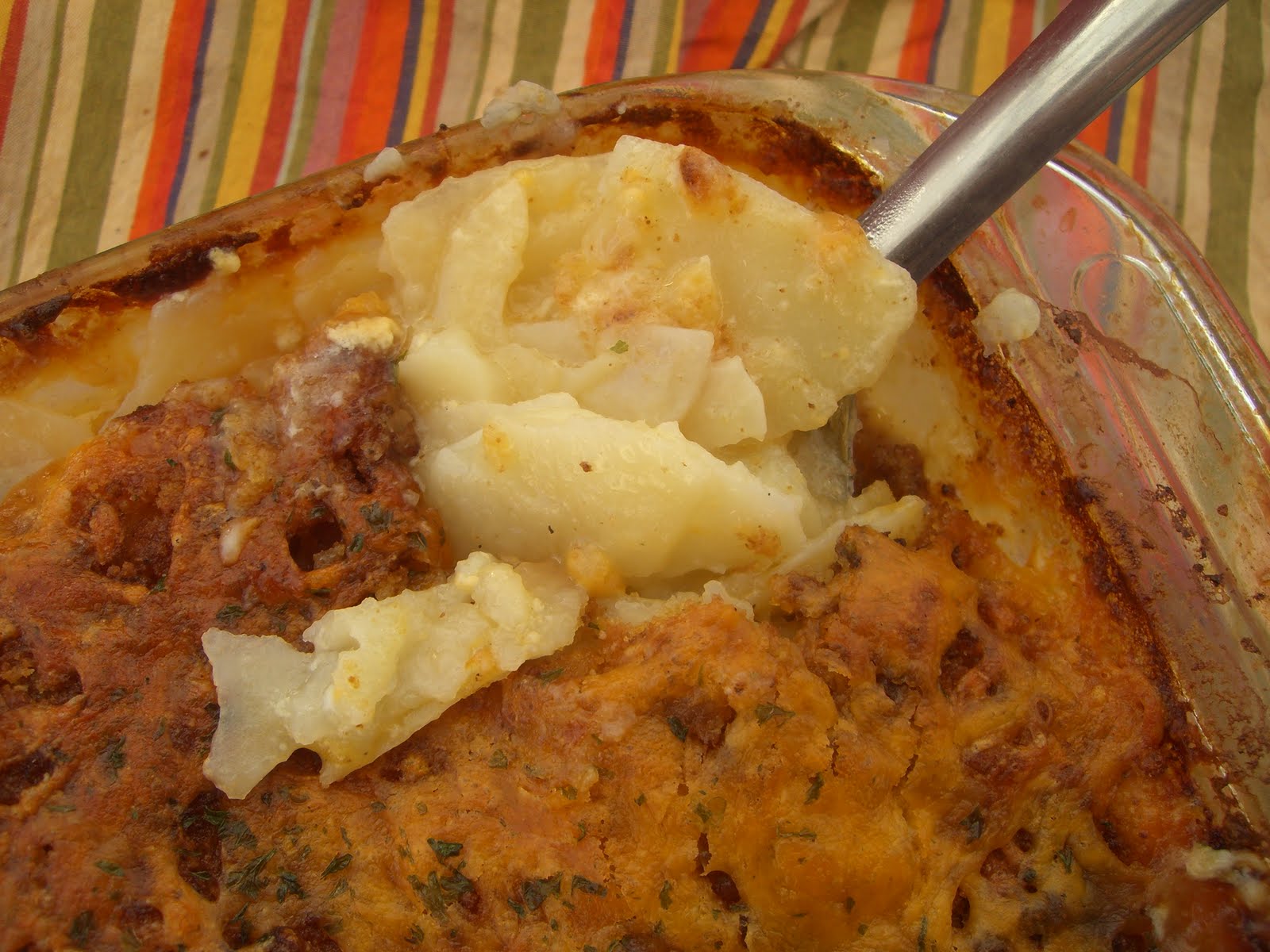
Cheesy Au Gratin Potatoes       Photo by Valerie Phillips

Idaho's governor,  C.L. "Butch" Otter went on the defensive Tuesday after a new Harvard study published in the New England Journal of Medicine concluded regularly eating potatoes contributes to weight gain.


According to an Associated Press article, the Governor's response was — Duh! 
Otter said that regularly eating any kind of food irresponsibly can lead to weight gain and health problems.
Otter also panned the study for failing to adequately explore the nutritional value of spuds and unfairly singling out tubers as a weight-gain culprit. 

Potato-Leek Soup      Photo by Valerie Phillips
I am pretty sure potatoes aren't the bad boy of the food world; it's the company they keep. For instance, all the grease in french fries and potato chips. The cream and butter in mashed potatoes. The loaded baked potatoes bursting with bacon bits, sour cream and cheese. Potato salad liberally doused with mayonnaise. And things like Cheesy Au Gratin Potatoes (although you can mitigate the damage a bit by using milk instead of cream). But they're almost diet food compared with Mormon Funeral Potatoes, where hash brown potatoes are swimming in butter, sour cream, melted cheese and cream of chicken soup. 

But there are plenty of potato dishes that aren't high in fat.  One is my recipe for Potato-Leek Soup, which can be made with fat-free half-and half. It has a velvety texture, and the leeks give it a delicate flavor.  A package of Steam “n” Mash russet potatoes streamlines preparation to less than 30 minutes total. You can also use frozen diced hash brown potatoes, or peel and dice fresh ones, but you should allow more cooking time.


Leeks are like giant green onions or scallions.  I like to cook the tender white  parts with the potatoes, and use the dark green parts as a garnish.

POTATO-LEEK SOUP
1 tablespoon butter
2 medium-size leeks 
1 teaspoon garlic powder or 1 clove of garlic
2 14-ounce cans chicken broth 
1 24-ounce bag Steam ‘N’ Mash russet potatoes
1 teaspoon salt
1/2 teaspoon freshly ground pepper, or to taste
1 cup fat-free half-and-half,  or milk 
Melt the butter over low heat in a stock pot. Meanwhile, rinse the leeks. On a cutting board using a chef’s knife, slice the white and light green parts in about 1/4 inch slices. You should have about 3/4 cup. Reserve some of the dark green part to use as a garnish.

Raise  the heat to medium-high and add the white and light green leek slices, and garlic. Stir and cook for 3-4 minutes, until leeks are wilted and fragrant. Add the chicken broth, potatoes, salt and pepper. Cover the pot and bring soup to a gentle boil for about 10 minutes, until potatoes are falling apart.


Remove from the heat and stir in the half-and-half or milk. 
Puree the mixture in a stand blender, in two batches; or use a hand-held blender to puree until smooth. Taste and adjust seasonings if necessary. If soup seems to thick, thin with a little water or milk.

To serve, top with green leek slices. Makes about 4 1-1/2- cup servings.


Tuesday, July 5, 2011

GOING NUTS OVER WALNUTS

Spinach and walnut salad                                        Photo by Valerie Phillips

I like all kind of nuts, but walnuts are probably my least favorite.
I guess that's because they are usually embedded in a recipe such as banana bread or brownies. I prefer nuts that have that "party food" vibe going on, such as cashews, almonds or even peanuts.
But I'm changing my opinion since finding out that walnuts are the only nuts that are high in that all-important omega-3 fat. While I was in Charleston at the Food News Seminar in April, I met Kaley Todd, a spokesman for California Walnuts.  She told me that walnuts contain 2.5 grams of alpha-linolenic acid (an omega-3 fatty acid) per ounce — way more than any other type of nut.  So, I wrote a column about them in this week's Deseret News .
Omega-3 fats are thought to reduce the risk of heart disease and stroke, reduce symptoms of depression, attention deficit hyperactivity disorder, joint pain and rheumatoid problems.
Some research links omega-3s with boosting the immune system to help protect from illnesses such as Alzheimer's disease.
Other good sources of omega-3s are coldwater fish, such as salmon, and flax seed.
Due to the strength of clinical studies supporting walnuts and cardiovascular health, the U.S. Food and Drug Administration approved a health claim for walnuts in 2004, that "eating 1.5 ounces of walnuts per day, as part of a low saturated fat and low-cholesterol diet, and not resulting in increased caloric intake, may reduce the risk of coronary heart disease."
The catch is the "not resulting in increased caloric intake." Because whether it's "good" fat or "bad" fat, walnuts still contain lots of fat. An ounce of walnuts, which is 1/4 cup of shelled halves or pieces, contains 190 calories; 160 of those calories comes from fat.
Todd said the point is not to ADD nuts to your existing diet, but to SUBSTITUTE them for some of the high-fat stuff you're already eating.
Maybe it's that handful of potato chips, or an extra slice of dessert. That way, you're still taking in the same amount of calories, but they're healthier calories.  (Yes, I know, it's easier said than done. But, it's a thought....) 
And you don't have to eat a whole lot of walnuts at a time for them to do you some good.
They're expensive, but a little can go a long way. You can sprinkle chopped walnuts on your cereal. I like sprinkling them on a salad. When I sauté asparagus spears, I like to toss in a handful of chopped nuts as well.
I've made fragrant pesto with walnuts instead of the usual pine nuts, which are more pricey. 
Use the fresh basil growing in your summer garden; or buy a big bunch of basil at a farmers market. 

Here's a recipe for a walnut-based pesto, adapted from "The Silver Palate Cookbook," by Julee Rosso & Sheila Lukins.The pesto is good as a dip, or tossed into pasta or soup (especially minestrone). And you can freeze it to use later.

Basic Pesto
2 cups fresh basil leaves
4 medium cloves garlic, chopped
1 cup walnuts
1 cup olive oil
1 cup grated Parmesan cheese
¼ cup grated Romano cheese (optional)
Salt and pepper to taste
Process basil, garlic, walnuts in a food processor. With the machine running, add olive oil. Add cheeses, a liberal dose of salt and a thin grinding of pepper.
Remove to a bowl and cover until ready to use.
Or, divide into small, plastic containers and freeze.
— adapted from"The Silver Palate Cookbook," by Julee Rosso & Sheila Lukins

Tuesday, June 7, 2011

MYPLATE NEW DIETARY GUIDELINES


MyPlate Succeeds MyPyramid
Although it took w-a-y too long to come up with it, the USDA has finally unveiled an icon for the 2010 U.S. Dietary Guidelines (which weren't published until Feb. 2011.  Those government wheels  turn pretty slowly.)


I'm happy to see a return to something that's simple to figure out at a glance.  It's pretty easy to understand that half of your meals should be fruits and vegetables, with veggies taking up the largest amount. That's a change from  the usual "one meat, one starch and one vegetable" approach to a meal. And dairy is clearly designated as the drink of choice, although cheese, yogurt, fortified soy milk, etc. can satisfy the recommended three servings a day. At  MyPlate.gov, you can click on the plate icon for  in-depth information on each food group.


The government has been issuing some form of dietary guidelines since 1894, but probably the best remembered was the "Basic Four" in 1956, which divided food into four main groups — dairy, protein, fruits and vegetables, and grain products. It was widely used for the next 20 years.  I think MyPlate is a return to that simplicity.


In 1992, the Food Guide Pyramid came out, suggesting servings from each of five major food groups — the bread and cereal group, the vegetable group, the fruit group, the dairy group and the protein group — and recommended sparing use of fats, oils and sweets.


In 2005, it was changed to MyPyramid, and showed a picture of someone running up the steps of the food pyramid as a way to stress the need for exercise. Consumers had to visit the MyPramid website to figure out their own personal nutrition information. I don't know if many people took the time to do it.


The dietary guidelines are based on the latest developments in nutritional science, with a bit of politics from the food industry, trade organizations and food activists. The guidelines serve as the basis for federal food and nutrition programs such as the USDA's school lunch program. And they are supposed to set the dietary tone for the country — although many of us don't follow it very well.


The new report noted that obesity is rampant: More than one-third of children and more than two-thirds of adults in the U.S. are reportedly overweight or obese. No surprises there.
Gee, did we really need a huge scientific government program to help us figure out that we are eating too much salt, too much sugar and too much fat? Is anyone shocked to find out that we need to eat more fruits and vegetables, whole grains and fat-free or low-fat dairy products?
In the fall, the MyPlate.gov will launch a suite of interactive web-based tools:


Daily, personalized food plans.
Daily food plans for kids.
Daily food plans for new mothers and pregnant women.
MyFoodapedia: information on food groups, calories, and food comparisons.
Food Tracker: feedback on your food intake and physical activity
Food Planner: a tool to plan meals that will help you reach personal goals.